


Rebuilding the Corners Where Community Happens: Valerie’s Story that learning and living doesn’t come with an age limit
Some people arrive in a community quietly, others arrive with a spark, a story and a lifelong curiosity that enriches the place around them. Valerie Merwood, a day-one resident of The Avenue Maroochydore, is one of those people.
Valerie and her husband watched The Avenue rise from its very first community meeting held across the road at the Catholic Church. They braved the rain for the sod-turning, wandered over to watch construction, and moved in on opening day alongside two couples and one single lady.
“We were the pioneers,” she laughs.
Their journey to The Avenue wasn’t straightforward. They sold their previous home in Bli Bli before The Avenue was complete and spent three months living temporarily at Litchfield in Corinda. “Our little Brisbane holiday,” Valerie calls it. However, the moment The Avenue opened in 2019, it felt right, it felt like home.
A Lifetime of Learning and a New Chapter
Valerie is a farming girl from the central high country of New Zealand. After raising her children and pursuing a career in farming, Valerie completed a bachelor’s degree in History in her 40’s, followed by degrees in Economics and Philosophy. Soon after graduating, Valerie began her career in education, teaching economics at her local school. She and her husband later immigrated to Australia to be closer to family, eventually retiring fully and travelling extensively.
“We’ve visited around 90 countries, or over 100 if you count return trips,” she says. “We’re not city people. We love the land, how it’s used, how it’s formed.”
From waterfalls in Europe to the white-rock mountains of Croatia and the earthquakes of New Zealand, Valerie’s fascination with landscapes has never faded.
So this year, in her 80s, she returned to university, “partly for fun, partly for dementia prevention,” and enrolled in an online geography course through Curtin University. She earned a distinction in Physical Geography and is now studying Human Geography. Her first big assignment required her to explore the idea of place. Naturally, she chose The Avenue.
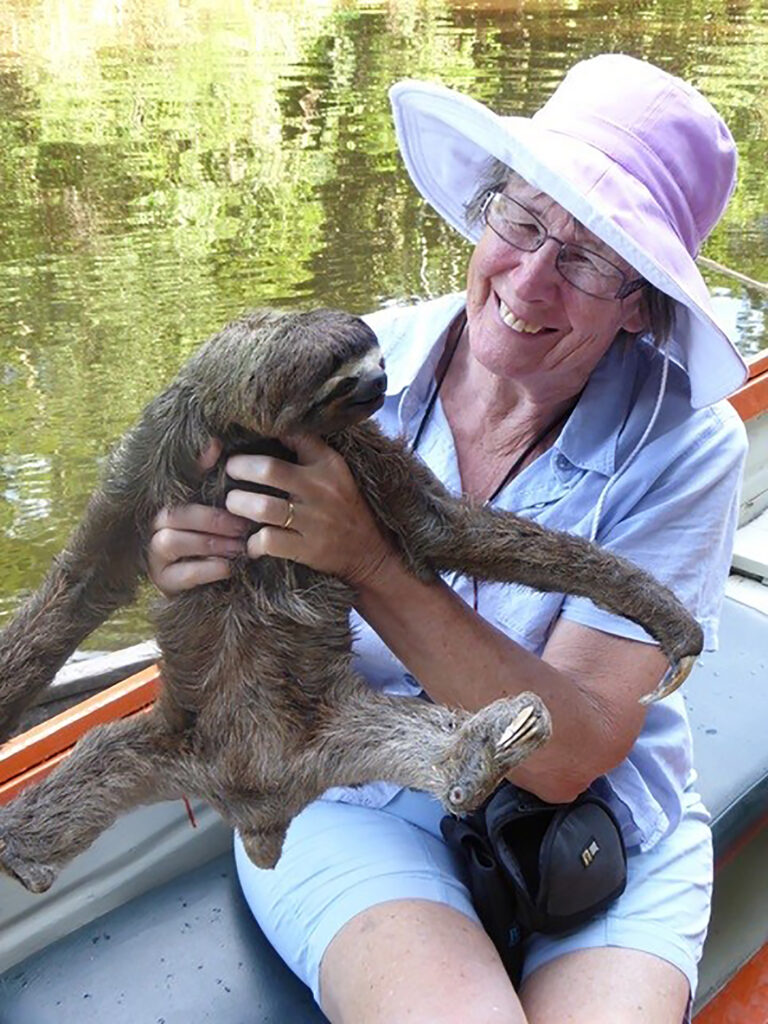
Val with a sloth in the Amazon
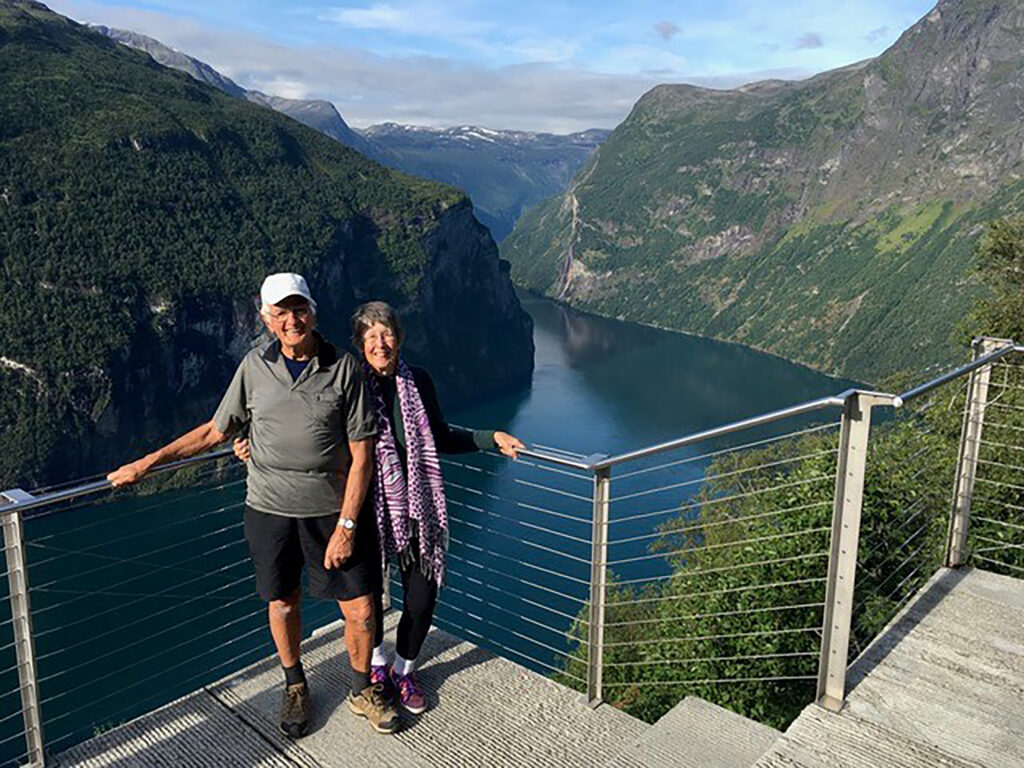
Val and Noel at Geiranga Fjord, Norway
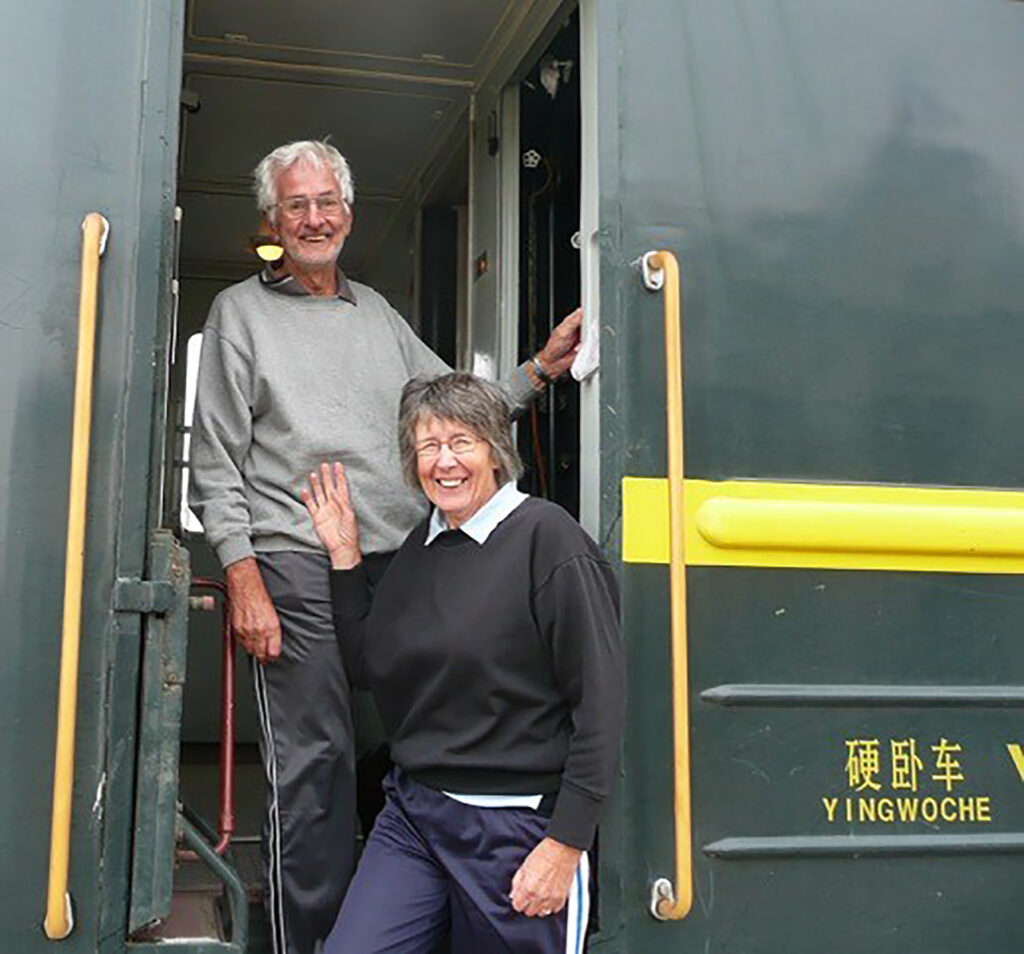
Val and Noel boarding the Trans-Siberian train
Valerie’s Essay: Understanding the Place We Live
In her essay, Valerie explored the local and global forces shaping her community, starting with The Avenue itself, then widening to Maroochydore, and finally the Sunshine Coast as a growing regional city.
She described Maroochydore’s unusual development:
“Unlike many global cities that grew outward from a historic centre, the Sunshine Coast evolved as a mosaic of decentralised towns. When the region was officially named a city, it didn’t yet have a true city centre. That emerged only after council resumed Horton Park Golf Course and began reshaping the heart of Maroochydore into “Australia’s first greenfield CBD.”
Her essay observed something striking about modern coastal development:
“Canal and apartment living does not favour the communal living preferred by Indigenous and/or migrant communities. There is coffee and cake aplenty but no old community corners for mate-ship and gossip. Up-market residents and visitors tend to make their connections on their balconies, in the multi-ethnic restaurants or in the popular party-precincts,” Valerie wrote in her essay.
This particular quote is something that Aura Holdings’ CEO, Sean Graham, identified as the most powerful insight. “Valerie is essentially describing what we are trying to create here at Aura,” said Graham, “community corners for mate-ship.”
In a rapidly modernising landscape, Valerie noted, the human-scale “corners” that once supported everyday connection have disappeared.
Where Aura’s Philosophy Meets Valerie’s Perspective
Aura Holdings was founded to address this very issue.
Instead of building retirement villages on isolated suburban fringes, Aura develops communities like The Avenue within established towns—so residents remain part of the local rhythm, not separated from it.
Valerie recognised this difference immediately:
“We have a small home (our apartment) in a large home (the facility). And we live among our townspeople, we feel part of the area, not apart from it.”
At The Avenue, the old-style “community corners” reappear in new forms:
- The buzzing café run by Compass Group
- The internal courtyard and garden spaces where conversations spark
- The lounge areas, clubs and activity rooms
- The walkable neighbourhood just outside the front door
These are the places where friendships form, stories are shared and residents reconnect with familiar faces they never expected to see again.
Connections Too Remarkable to Be Coincidence
Valerie’s everyday experiences at The Avenue reflect the type of community Aura aims to create. In her “little section”—apartment 20 and the neighbours nearby—she discovered a cluster of fellow New Zealanders:
- One couple lived just 35 minutes from her hometown
- Another neighbour trained for years in the New Zealand Army near her region
- A woman she last saw at boarding school when Valerie was 17—reunited unexpectedly at a pedestrian crossing outside The Avenue, later moving into the building with her husband
“These little connections,” Valerie says, “felt gifted to us.”
A Place to Belong, not Just to Live
Valerie’s essay ends with a reflection on “glocalisation” the mixing of local and global influences that shape modern cities. For her, The Avenue is the perfect example: globally informed, locally grounded, socially rich.
“We are well content in this place,” she writes.
And in many ways, Valerie’s journey mirrors the story of The Avenue itself:
A place built intentionally.
A place shaped by community.
A place where people reconnect, reinvent themselves and rediscover purpose.
A place where the “community corner” still matters.
Aura didn’t just build an apartment complex, they built a neighbourhood.
And residents like Valerie ensure it remains a place full of life, learning, friendship, and meaning.